Food Industry Asia
-
DATABASE (546)
-
ARTICLES (584)
Fast like the wind, Mr Feng’s army of mobile-technology-enabled “courier-warriors” provide reliable on-demand intracity delivery for individuals and businesses; and is Hangzhou’s No. 1 player.


Fast like the wind, Mr Feng’s army of mobile-technology-enabled “courier-warriors” provide reliable on-demand intracity delivery for individuals and businesses; and is Hangzhou’s No. 1 player.
Proppos FastPay's food-recognition technology decreases checkout times to 5-10 seconds and its AI-driven predictive consumption models optimizes operational efficiency.

Proppos FastPay's food-recognition technology decreases checkout times to 5-10 seconds and its AI-driven predictive consumption models optimizes operational efficiency.
R&D and business lead and co-founder of Graviky Labs
Anirudh Sharma is one of three co-founders of Graviky Labs, which makes ink out of carbon that is captured from pollution and purified using proprietary technology. This concept was born from Sharma’s experiments making ink from candle soot while doing his master’s at MIT Materials Lab. He currently leads R&D and business at the firm. Sharma’s interests include augmented reality, wearable computing and environmental projects. Over the years, he has developed and patented various technology products with social and environmental impact. He was formerly CTO and co-founder of India’s first wearable technology company, Ducere Technologies, which was later sold. This company makes Lechal, the world’s first smart haptic device for shoes, initially designed by Sharma as a navigation aid for the visually impaired. Sharma also previously worked for Imagin Group at Hewlett Packard Labs, on a multimodal speech and touch-based computer-aided design interface for large displays.Sharma holds a master's from Massachusetts Institute of Technology and co-led the activities of MIT Media Lab India from 2013–2015. He is a TED and TEDx speaker and has been included in Forbes’ 30 Under 30 for Asia, MIT Technology Review’s 35 Innovators Under 35, and Foreign Policy magazine’s 100 Global Thinkers of 2016.

Anirudh Sharma is one of three co-founders of Graviky Labs, which makes ink out of carbon that is captured from pollution and purified using proprietary technology. This concept was born from Sharma’s experiments making ink from candle soot while doing his master’s at MIT Materials Lab. He currently leads R&D and business at the firm. Sharma’s interests include augmented reality, wearable computing and environmental projects. Over the years, he has developed and patented various technology products with social and environmental impact. He was formerly CTO and co-founder of India’s first wearable technology company, Ducere Technologies, which was later sold. This company makes Lechal, the world’s first smart haptic device for shoes, initially designed by Sharma as a navigation aid for the visually impaired. Sharma also previously worked for Imagin Group at Hewlett Packard Labs, on a multimodal speech and touch-based computer-aided design interface for large displays.Sharma holds a master's from Massachusetts Institute of Technology and co-led the activities of MIT Media Lab India from 2013–2015. He is a TED and TEDx speaker and has been included in Forbes’ 30 Under 30 for Asia, MIT Technology Review’s 35 Innovators Under 35, and Foreign Policy magazine’s 100 Global Thinkers of 2016.
Co-CEO and Co-founder of Notpla (formerly Skipping Rocks Lab)
Rodrigo García González graduated in Architecture at the Technical University of Madrid (ETSAM) in 2009 and also completed various PhD courses in advanced architecture at his alma mater.In 2006, the architect student joined an EU Asia-Link sustainable humane habitat program that included stints at the Centre for Environmental Planning and Technology (CEPT) University in India. He also won a SMILE scholarship to study industrial design at Pontificia Universidad Católica in Chile for one year. In 2011, he obtained a scholarship to study industrial design and business at Umeå Institute of Design in Sweden. In 2014, he completed two master’s programs in innovation design engineering run by London’s Imperial College and Royal College of Art.In July 2014, he co-founded Skipping Rocks Lab, that was later pivoted into Notpla, a UK-based startup that develops compostable and edible packaging materials made of seaweed and other plants.Since 2007, he has worked with various institutions in Europe, Latin America and the US including Cornell University, CEPT, Imperial College and Royal College of Art. In 2016, he became a senior lecturer for a degree program in product and furniture design at Kingston University.He has two patents for his work on structural and deployable systems. His designs have also been featured in prestigious art centers like the Cite de l'Architecture of Paris and the Venice Biennale of Architecture.Other projects include the Hop! suitcase that can follow the user by tracking the signal of the user’s mobile phone and Aer, an artificial cloud that can evaporate “drinkable” water from the sea. He also developed Zipizip, an architectural system that enables the construction of several floors of a building in a few hours.

Rodrigo García González graduated in Architecture at the Technical University of Madrid (ETSAM) in 2009 and also completed various PhD courses in advanced architecture at his alma mater.In 2006, the architect student joined an EU Asia-Link sustainable humane habitat program that included stints at the Centre for Environmental Planning and Technology (CEPT) University in India. He also won a SMILE scholarship to study industrial design at Pontificia Universidad Católica in Chile for one year. In 2011, he obtained a scholarship to study industrial design and business at Umeå Institute of Design in Sweden. In 2014, he completed two master’s programs in innovation design engineering run by London’s Imperial College and Royal College of Art.In July 2014, he co-founded Skipping Rocks Lab, that was later pivoted into Notpla, a UK-based startup that develops compostable and edible packaging materials made of seaweed and other plants.Since 2007, he has worked with various institutions in Europe, Latin America and the US including Cornell University, CEPT, Imperial College and Royal College of Art. In 2016, he became a senior lecturer for a degree program in product and furniture design at Kingston University.He has two patents for his work on structural and deployable systems. His designs have also been featured in prestigious art centers like the Cite de l'Architecture of Paris and the Venice Biennale of Architecture.Other projects include the Hop! suitcase that can follow the user by tracking the signal of the user’s mobile phone and Aer, an artificial cloud that can evaporate “drinkable” water from the sea. He also developed Zipizip, an architectural system that enables the construction of several floors of a building in a few hours.
Revolutionizing the world of food traceability, SwissDeCode’s DNA technology allows anyone to test for contaminants and provide certifications in minutes, automatically or offline.

Revolutionizing the world of food traceability, SwissDeCode’s DNA technology allows anyone to test for contaminants and provide certifications in minutes, automatically or offline.
Bamboo Capital Partners is an impact investment company that focuses on supporting energy access, finance and healthcare-related ventures in developing countries. The company manages 10 investment funds across Asia, Africa, and Latin America, with companies in Indonesia, India, Kyrgyz Republic, and Brazil having received investments from this company. Bamboo Capital Partners states that their portfolio healthcare companies have served 3.4m patients, and 9.68m metric tons of CO2 emissions have been avoided through the use of solar panels and green energy championed by their startups.Bamboo Capital Partners have worked with governments and major investment groups to support the fulfillment of SDG goals through startup investing. In 2020, Bamboo Capital Partners was appointed by the government of Madagascar and the World Bank as the fund manager for the $40m Off-Grid Market Development Fund. Bamboo is also a partner of the Palladium Group, which owns a minority stake in the VC.

Bamboo Capital Partners is an impact investment company that focuses on supporting energy access, finance and healthcare-related ventures in developing countries. The company manages 10 investment funds across Asia, Africa, and Latin America, with companies in Indonesia, India, Kyrgyz Republic, and Brazil having received investments from this company. Bamboo Capital Partners states that their portfolio healthcare companies have served 3.4m patients, and 9.68m metric tons of CO2 emissions have been avoided through the use of solar panels and green energy championed by their startups.Bamboo Capital Partners have worked with governments and major investment groups to support the fulfillment of SDG goals through startup investing. In 2020, Bamboo Capital Partners was appointed by the government of Madagascar and the World Bank as the fund manager for the $40m Off-Grid Market Development Fund. Bamboo is also a partner of the Palladium Group, which owns a minority stake in the VC.
Boasting the world’s largest network of videographers, Pear Video produces 1,500 short videos each day and attracts over 1 billion daily views.

Boasting the world’s largest network of videographers, Pear Video produces 1,500 short videos each day and attracts over 1 billion daily views.
Bezos-backed Chile’s first unicorn uses proprietary AI algorithm to analyze food molecules to produce plant-based meat and dairy products that taste like the original.

Bezos-backed Chile’s first unicorn uses proprietary AI algorithm to analyze food molecules to produce plant-based meat and dairy products that taste like the original.
H&M’s first shop was founded 74 years ago in Sweden by Erling Persson under the name “Hennes”, Swedish for "hers" since the shop was selling only women's apparel. In 1968, Persson expanded into menswear by acquiring Swedish retailer Mauritz Widforss. Hence the rebranding of the company into Hennes & Mauritz (H&M). In 1974, H&M was listed on the Stockholm Stock Exchange. Since then, H&M has expanding internationally opening its first store in London and the rest of Europe and also to the US in early 2000.In 2008, the company also moved into the home furnishings segment and launched H&M Home stores worldwide. The fashion chain can now be found across Europe, the US, Asia and the Middle East. The group expanded further by acquiring fast-fashion brands like Weekday, Monki and Cheap Monday. In April 2021, H&M Group announced a collaboration with textile cleantech Infinited Fiber to launch proof-of-concept denim created wholly from regenerated textile waste as part of its commitment to use only recycled or sustainably sourced materials by 2030.

H&M’s first shop was founded 74 years ago in Sweden by Erling Persson under the name “Hennes”, Swedish for "hers" since the shop was selling only women's apparel. In 1968, Persson expanded into menswear by acquiring Swedish retailer Mauritz Widforss. Hence the rebranding of the company into Hennes & Mauritz (H&M). In 1974, H&M was listed on the Stockholm Stock Exchange. Since then, H&M has expanding internationally opening its first store in London and the rest of Europe and also to the US in early 2000.In 2008, the company also moved into the home furnishings segment and launched H&M Home stores worldwide. The fashion chain can now be found across Europe, the US, Asia and the Middle East. The group expanded further by acquiring fast-fashion brands like Weekday, Monki and Cheap Monday. In April 2021, H&M Group announced a collaboration with textile cleantech Infinited Fiber to launch proof-of-concept denim created wholly from regenerated textile waste as part of its commitment to use only recycled or sustainably sourced materials by 2030.
Notpla (formerly Skipping Rocks Lab)
Compostable and edible seaweed-based packaging in a flexible product for many uses to replace polluting plastic, winning accolades from WIRED, Fortune and TIME.

Compostable and edible seaweed-based packaging in a flexible product for many uses to replace polluting plastic, winning accolades from WIRED, Fortune and TIME.
LeapFrog Investments is an impact-focused investor, managing over $1.6bn in assets mainly investing in Africa and Asia. Its “profit with purpose” has led to investments in startups that provide healthcare, financial services and insurance for low-income consumers. Since it was founded in 2007, LeapFrog has attracted funds from Prudential, AXA, Swiss Re and Omidyar Network, becoming the first impact investor in the world to reach the $1bn milestone. It’s headquartered in South Africa and Singapore.LeapFrog is best known for its investments in the insurance sector. One of the most prominent companies in its portfolio is BIMA, the mobile-based insurance provider that has provided coverage in Ghana, Bangladesh, Cambodia and many other countries. In 2020, LeapFrog invested in Indonesian startup PasarPolis, which is a broker for a wide range of microinsurance products. In the healthcare and biotechnology sectors, LeapFrog has funded Indian genetic diagnostics company MedGenome, as well as Goodlife Pharmacy, a Kenyan company providing access to affordable medicine in the East African country.
LeapFrog Investments is an impact-focused investor, managing over $1.6bn in assets mainly investing in Africa and Asia. Its “profit with purpose” has led to investments in startups that provide healthcare, financial services and insurance for low-income consumers. Since it was founded in 2007, LeapFrog has attracted funds from Prudential, AXA, Swiss Re and Omidyar Network, becoming the first impact investor in the world to reach the $1bn milestone. It’s headquartered in South Africa and Singapore.LeapFrog is best known for its investments in the insurance sector. One of the most prominent companies in its portfolio is BIMA, the mobile-based insurance provider that has provided coverage in Ghana, Bangladesh, Cambodia and many other countries. In 2020, LeapFrog invested in Indonesian startup PasarPolis, which is a broker for a wide range of microinsurance products. In the healthcare and biotechnology sectors, LeapFrog has funded Indian genetic diagnostics company MedGenome, as well as Goodlife Pharmacy, a Kenyan company providing access to affordable medicine in the East African country.
TurtleTree Labs will license its technology for creating natural ingredients found in human milk to dairy and infant formula companies to produce full-composition liquid milk.
TurtleTree Labs will license its technology for creating natural ingredients found in human milk to dairy and infant formula companies to produce full-composition liquid milk.
Founded in 1998, Asiaec Partnership is one of the earliest venture capital firms in China, with about 20 funds under management. It has invested in 100+ companies, of which about one-third have gone public, with an IRR of over 35%.

Founded in 1998, Asiaec Partnership is one of the earliest venture capital firms in China, with about 20 funds under management. It has invested in 100+ companies, of which about one-third have gone public, with an IRR of over 35%.
Co-founder and CEO of Kioson
Jasin Halim read a master’s in Marketing and Finance at Monash University in 1990, while working as a lecturer in Computer Science. He returned to Indonesia in 1992 to establish a mail order company that was shut down due to the 1998 Asian financial crisis. Undaunted, he went on to establish a TV shopping company and a VOIP company. He also founded PT Mitra Cipta Teknologi, the company behind e-commerce HargaHot in 2012. However, Jasin later decided to quit HargaHot to co-found Kioson in 2015.

Jasin Halim read a master’s in Marketing and Finance at Monash University in 1990, while working as a lecturer in Computer Science. He returned to Indonesia in 1992 to establish a mail order company that was shut down due to the 1998 Asian financial crisis. Undaunted, he went on to establish a TV shopping company and a VOIP company. He also founded PT Mitra Cipta Teknologi, the company behind e-commerce HargaHot in 2012. However, Jasin later decided to quit HargaHot to co-found Kioson in 2015.
Co-founder and CEO of eFishery
Gibran Huzaifah ran a composting business and a catfish farm while reading a degree in Biology at Institut Teknologi Bandung in Indonesia. After graduating in 2012, he teamed up with fellow ITB alumnus Chrisna Aditya to establish an aquaculture tech firm PT Multidaya Teknologi Nusantara, aka Cybreed. In 2013, it launched eFishery, an automatic feeder system for aquaculture farms. In 2017, Gibran’s achievements earned him a spot on Forbes’ 30 Under 30 list of notable Asian figures.

Gibran Huzaifah ran a composting business and a catfish farm while reading a degree in Biology at Institut Teknologi Bandung in Indonesia. After graduating in 2012, he teamed up with fellow ITB alumnus Chrisna Aditya to establish an aquaculture tech firm PT Multidaya Teknologi Nusantara, aka Cybreed. In 2013, it launched eFishery, an automatic feeder system for aquaculture farms. In 2017, Gibran’s achievements earned him a spot on Forbes’ 30 Under 30 list of notable Asian figures.
Future Food Asia 2021: Long road ahead for the clean meat industry
Crucial basic research is still needed to ensure the safety, quality, and production efficiency of lab-grown meat. Concerted public and private sector efforts will accelerate progress

Future Food Asia 2021: Regenerative agriculture in Asia
The unique challenges facing regenerative agriculture in Asia require solutions different from those in the West, presenting opportunities for microfinancing and impact investment

Delectatech: "Food data" proves its value in Spain's Covid-hit F&B industry
Delectatech deploys AI, NLP and big data to help restaurants and food suppliers optimize business information, decisions and operations

Future Food Asia 2021 announces finalists for $100,000 prize
Ten startups from agrifood tech and cleantech sectors will pitch during the five-day conference, are also eligible for two more prizes from sponsors Cargill and Thai Wah

Future Food Asia 2021: Consumers crucial for agrifood growth
President of AppHarvest David Lee thinks consumers must be told the truth about the need for technology for change in food because capitalism and consumerism are powerful forces

New Food Invest: Growing an alternative protein business in Asia
With more than 4bn people, Asia presents unique opportunities and challenges to alternative protein startups. Four leading entrepreneurs shared their experiences at the recent New Food Invest conference

Future Food Asia 2021: Agrifood tech at an inflection point
Agrifood tech startups urged to harness consumer, investor and government feedback to create plentiful, nutritious food through sustainable means, but exercise caution when considering IPOs

Future Food Asia 2021: Impact assessments – getting the metrics right
Common impact measures are useful but each situation requires specific, sometimes subjective considerations. The priority is to gauge if the impact has led to positive changes

Future Food Asia 2021: Two winners take home $100,000 each
Agrifood startups, corporations and investors urged to collaborate and take action, tackling challenges in nutrition and climate change
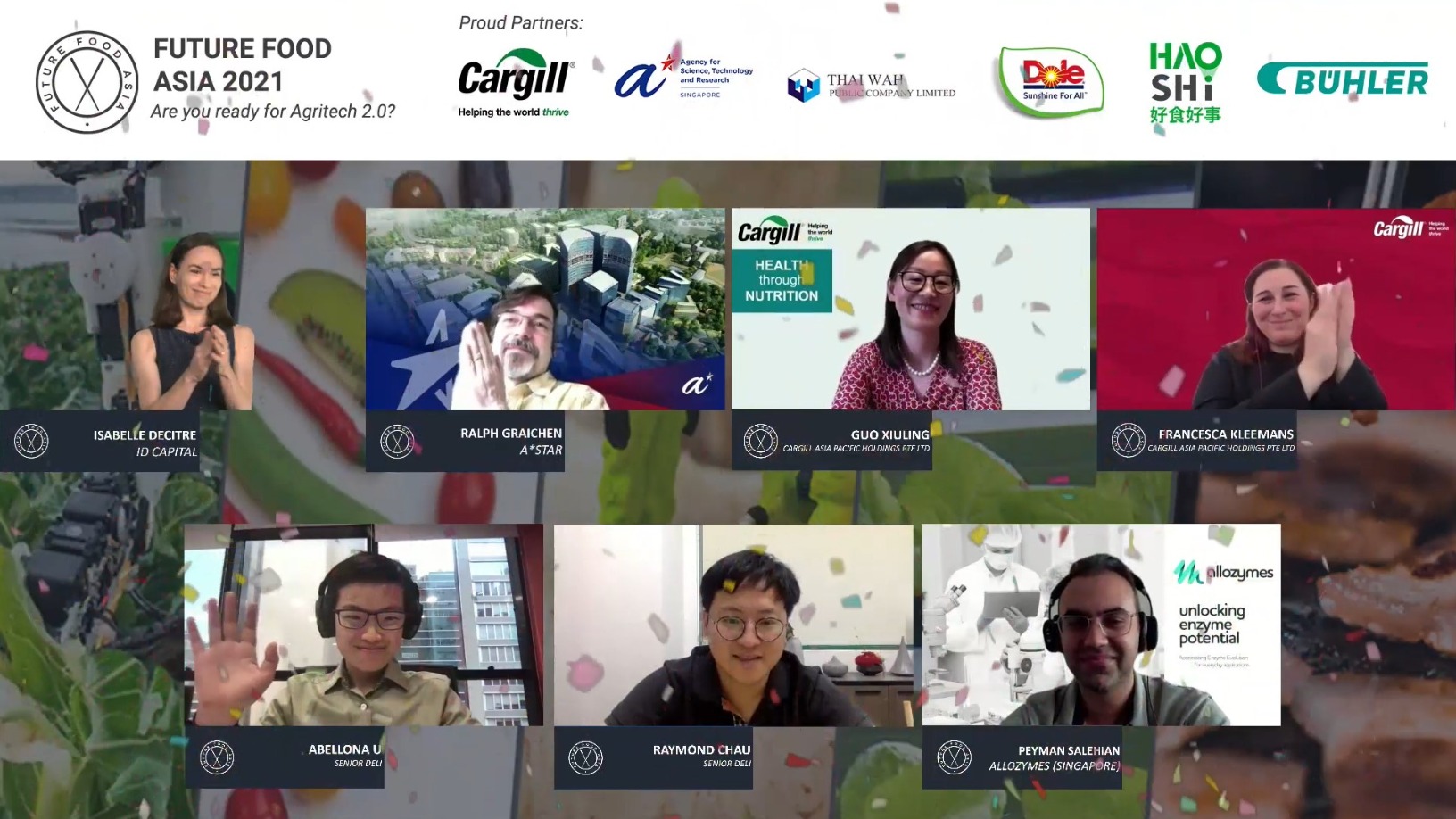
Future Food Asia 2021: Fireside chat with Green Monday's David Yeung
For Chinese startup Green Monday, it’s important to resonate with different local audiences by adapting to local culture and dietary habits and continuously fine-tuning existing products

Future Food Asia 2021: Potential of pulses in the alt-protein space
Asia presents a unique opportunity for pulses as people in the region, who traditionally fractionated pulses for starch, now see protein as a useful byproduct

Future Food Asia by ID Capital: Introducing Asia's agrifood startups to the world
More than a meeting of startups and investors, the conference showcases ID Capital’s investment thesis and Big Ag’s support for agrifood tech in the world’s most populous region
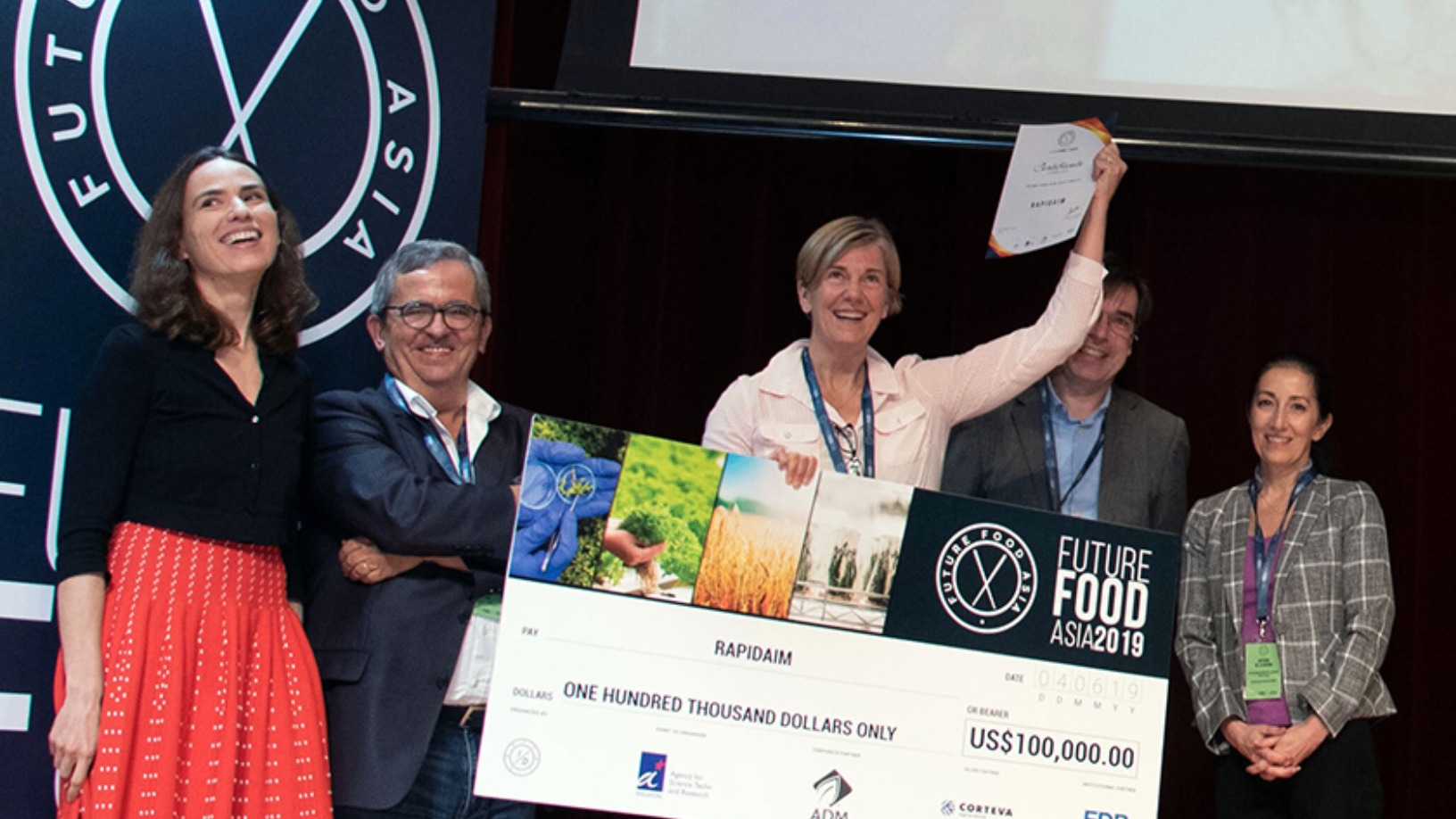
Big Idea Ventures Founder Andrew D Ive: Asia will lead cell-based meat innovation
In a wide-ranging interview, the managing general partner of the US- and Singapore-based foodtech investor also expounds on his goal to extend sustainability to the rest of the food sector, combining good returns with doing good

China a “positive environment” for uptake of cultured meat, researcher tells Future Food Asia
But for interested cultured meat companies, China-based Chloe Dempsey suggests it would be better to wait, observe and learn more about the market before trying to tap its massive potential

Future Food Asia: Covid-19 sparked dramatic shifts in agriculture in China and India
Key Chinese players from e-commerce giant Pinduoduo and and agritech VC Omnivore share their insights at last week’s agrifood conference by ID Capital

Sorry, we couldn’t find any matches for “Food Industry Asia”.
POPULAR DATABASE